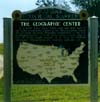
 "The geographic center of the USA" "The geographic center of the USA"
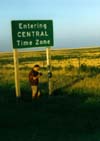
 my feet as the country's fulcrum my feet as the country's fulcrum

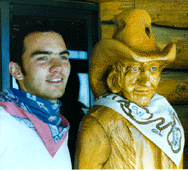
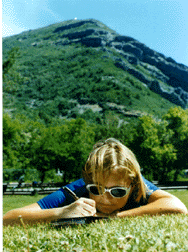
"just stretching officer"
|
Day 32-5 - Anton, CO to St. Francis, KS
to Oberlin, KS, to Philipsburg, KS to Beloit, KS
Someone must have clicked my heels together three times while I was sleeping, because all of a sudden I'm in Kansas.
I rode in, tired and worn, under cover of darkness, but Auntie Em still found me as I muttered deliriously, "There's no place like home..."
She thought I was talking about her place. Kansas Kate has lived in St. Francis for 50 of her 68 years. Her husband Warren brought her there after they married, "cause I thought me and this town could change her, calm her down a bit. But it was her that changed us." Kate is a playwright and grandmother of many, a homemaker and churchgoer. Her latest project is a musical called, "Dust on the Sunflowers" about the early days of the pioneers who settled in the St. Francis area. She's also working on a play about a group of older women, some of whom continue to have adventures in their lives, some of whom don't. As research for that piece, I'm not exactly sure why, she lived for several months in fraternities at UC Berkeley and UC Boulder. "Those boys loved me," she said, "wherever I went they would follow to make sure I'd be okay. Not that I couldn't handle myself perfectly well, but they liked helping out an old lady, so I let them."
Kate set me up in the renovated garage of the chief of police: only the second real bed and real shower I'd used in 6 weeks. I searched frantically for a phone line for my laptop: none. Not even a three prong plug to plug it into. So I resigned myself to sleep, but not before checking out the time: it was 11:00 and it had been light just over an hour ago...oh yeah, the Central Time Zone sign right before the Kansas border. Lost another hour...DC is getting closer all the time.
To Oberlin -
There have been days, like yesterday, where I have felt weak, debilitated and discouraged for some or all of the ride. Today, though, the only cause of that is the head wind. As we push across these amber waves of grain coming on us so abruptly after the purple mountains' majesty, it has been steadily pushing back. Today, without it, I am unstoppable, indefatigable, a man with a 65 mile mission - I signal the van to pull over as they pass me just to tell them how good I feel because the van driver always hears the worst.
Now that we have reached the prairie, there are few breaks in the wheat fields, few goals to set your short-term sights on (I'll make it up this hill or to that town or the lake they told be about) few sources of water and few people to liven things up. There is a state that I drift into which the other riders call "zoning", but in tennis to be "in the zone" means to be playing the best tennis you are capable of, but this is about a meditative state…so I call it, "being one with the white line."
It's not about cycling at your best, it's about your mind drifting far away from your legs and beating heart, while your eyes are mesmerized by the road five feet ahead of you. If there are cars, they are giving you a wide berth on these rural roads, leaving you alone with the hopping crickets chased from the wheat to the side of the road with sprayed ammonia, the buzzing cicada "om-ing" you further into your altered mid-western state, and the humid breezes bringing you scents of burning wheat chaff, stagnant cricks, far away barbecues, and the much more immediate roasting flesh and rubber of you and your machine. Being one with the white line can take you to far away places: a deli on Bleeker St. in Greenwich Village, a birthday party in Provincetown, people-watching on a bench in front of the health food store in the Castro.
Being one with the white line can also let you travel to the future: to a desk at the National Center for Lesbian Rights where I'm helping organize a benefit, to a computer terminal in an anonymous office Downtown where I'm designing a brochure to sell the new Product. To a meeting at the AIDS Foundation where I'm pitching my idea for a national support program for kids whose parents are HIV+ or have died of AIDS. To the apartment of Jack Davis, political consultant and all around jerk who has realized the errors of his ways and is giving himself paper-cut penance with his "Save the Dovre Club" signs, to a small dinner party with my mom and Charlotte in the kitchen of my new house.
Or I'm transported back in time to Hope's car, driving up to the new mall on Potrero Hill to run errands, talking about the first time we met; to sipping margaritas with the Beth and Rachel; to sipping wine in Napa Valley with Shani trying to top one another with oenophilic (or phobic) adjectives; to walking down Prospect Ave. in Brooklyn with Rodney, talking about all the young moms walking their babies with us who Rodney knew when they were energized high school students with big dreams; to coming home by myself from the airport in Toronto after months and months to find that my dad wasn't there, but instead he had left a treasure hunt in complete rhyme that lead me around the neighborhood and ultimately to the back of the house behind my room where he and his boyfriend, Sam, had strewn lights around a tree that I could turn on and off with a switch by my bed.
The white line has taken me to Oberlin and Beloit, the names of the colleges my parents attended. It's taken me along the road to the Philipsburg National Guard maintenance depot, which was sided by wild-growing marijuana, sometimes growing on acres of fallow wheat fields. In Philipsburg lives the sister of Jon Sims. Jon died of AIDS in 1984, but not before starting the lesbian and gay band of San Francisco, and leading the gay music movement, which, says Wendy, is the first time pre-AIDS that lesbians and gay men formed strong ties.
In San Francisco there is a Jon Sims Center where bands play, groups meet, events happen. I've been to several without knowing who he was.
In the PBS documentary on the Castro, the Van Ettens, the men who have lived there together for three decades, talk about Jon as the neighbor next door whom they abandoned out of fear when he got sick with "gay cancer". Wendy went to college with him and they stayed friends when they both moved to the City. She too was involved with the band, and when he died it was an enormous blow to her which took 6 years to overcome. She kept in touch with his family, especially his sister, who still lives where he grew up. They met for lemonade at the Subway, where I bumped into them, and then she took Wendy on a little tour of Jon's childhood: the school house where he was a leader of the band, the farm he used to hate to drive their tractor on, the spot near the high school where he would go to write and sew.
And as Wendy was telling me this story, I couldn't help but think of Dunn, North Carolina where my dad grew up. The church where he played the organ. The tobacco he used to hate to cure. The school teachers who unofficially adopted him when his own family was falling apart from his dad's alcoholism. His brother who died of a heart attach two years ago before I had gotten the courage to ask him for the same tour Wendy was on.
And then as I'm thinking of all this while cooking the seitan for dinner that I've waited three weeks for a kitchen to prepare, I notice that I'm burning the pot that the sauce is cooking in, and it's not ours. "Don't worry," says the National Guardsman who's our host, "I have a crew from the penitentiary come down and clean this place next week." We can't find flowers to hold in outstretched arms for our poses in front of the camouflaged armored transports out back.
The white line takes me to a marker which says that if you could cut out the US from the world and balance it, without those pesky forty-ninth and fiftieth states, the balance point would be not far from here. That's the center of the US. I take a picture of my feet, standing there, and imagine that I'm the fulcrum on which the country rests...the Atlas of the age. I shrug and ride on.
The white line takes me to a real Soda Fountain in downtown Beloit, which has 3 traffic lights, more than I've seen since Denver. There are more traffic lights than people, "because", says Carl who pulls my Green River soda for me, "it's after the harvest so most of 'em take off to Europe, and the ones that stay are gettin' ready for the next planting." Carl's shop is filled with curios that I can't imagine people buying in Beloit. Fancy candles and cards. Pens and potpourris and pet rocks. Ceramic figurines of all description, see-through fabrics and illustrated fiction. But then I remember the ranch house we stayed at in Walden, CO where Jackie had collections of many of these things, and I have a renewed respect for Carl who has run this shop for almost 20 years. For a moment I wonder why he's not one of the farmers, off in Europe now, but then I realize that it's 110 degrees outside and 85% humidity...the kind of weather that drove me into his air conditioned place to begin with, and my respect for this quiet Beloit native who is completely unimpressed by my transcontinental ride, reaches new heights.
That night, simply to escape the heat which runs unabated until one in the morning at which time it drops just enough to allow me to sleep a few hours on my damp sleeping bag before the sun comes up, I go to the theater in town with Adrian (18) and Anthony (16) to see Con Air. It is the best $2 I have ever spent. Not because of the million-dollar special effects, or the 10 tons of explosives, or the 4 actors (Meaney, Cusack, Cage and Malkovich) whom I like, or that we are the only 3 people in this dilapidated movie house and so can make all the juvenile noise and commentary we want. No, the best thing is the 64-inch diameter, 10 horse power fan that is blowing directly, incessantly and blessedly over my gooey, exhausted body.
------
Days 36-37 - Beloit to Salina, KS, rest day in Salina
It may not be Wichita, but by Kansas standards, Salina (long "eye") is a metropolis. We've known this for days because all the towns we've passed through have had the Salina daily newspaper, full-color pictures of school board meetings on the front cover and everything. We are told it's a 60 miles day to town, but at lunch 30 miles out, we learn there are 50 miles to go and it's only getting hotter and more humid. Just as the locals in Nevada reveled in telling us how far it was to the next source of water, the locals in Utah and Colorado loved to describe the grades that we were about to climb, the locals in Kansas get a sadistic, state-proud thrill in telling us how much hotter and stickier it will get as we ride east. "You think it's bad here," a farmer taking a lunch break, eating his chicken fried steak at the cafe you sit in will say when you tell him what you're doing, or he overhears you ask the server to fill your water bottle up with ice, "just wait until you get to Missouri."
Coming into Salina which is worse as we've been warned, Jerry, one of the safer riders, goes over a large, invisible bump while changing hand positions and is thrown over his handlebars to land on his shoulder. He is scraped and bloodied and his jersey is ripped. Tomorrow he will be sore and stiff from the impact. As I ride over the same bump a minute later without mishap, it reminds me how easy it can be to hurt yourself. I think of the white line: is that oneness safe? I think of riding next to other cyclists on these rural highways so that we can have a conversation, one of the few things that brings some joy or levity to these sweltering, mind-numbing rides. Even though we can see the road for miles behind us, sometimes we are taken by surprise and must quickly scoot over while shouting, "Car back, I'm up," if we push ahead, or "Car back, I'm back," if we quickly drop back behind. Invariably we are given a huge cushion, but what if that farmer in his '75 Chevy pick-up had been one with the white line at that moment, himself?
As I write this, I am in a dark, quiet room with a sloping stucco ceiling, surrounded by scattered chairs and books on stained, pine shelves lining the walls. The shelves are labeled such things as "Nuclear Warfare and Weapons", "Field Guides to Plants and Mushrooms" and "Urban and Regional Planning." This is the library of the Land Institute, a 20 year-old research farm just south of Salina. There are several staff and eight interns working here, with the ultimate goal of creating a prairie field that, through the right symbiotic combination of plants, will provide plentiful, consumable and perennial food without the use of artificial fertilizers, herbicides or pesticides. In short, they want to make prairie farming a eco-friendly, self-sustaining act that doesn't lead to the Great Dustbowl of the '30's or the farm failures of the 80's, or the pollution of water and draining of the Ogallala and other aquifers. It's a neat, neat place that is trying something which seems scary and radical to most farmers who cannot afford to experiment.
We have a rest day here, which means a rest from riding bikes; I spent the morning in long pants and muddy shoes with a bucket hung around my neck with twine, picking gamma grass seeds. Gamma grass is a native prairie grass which has been all but driven off by the prairie monocrops. It's a relative of corn, although I wouldn't have known that...apparently the grass hasn't changed too much over time, but corn, through hundreds of years of hybridization, preferential treatment of mutant strains, etc., has. The right kinds of gamma grass seeds can produce a meal much like corn meal, and so this is one of the crops that they hope to integrate with other crops to form the sustainable, harvestable prairie. We are picking seed by hand instead of by combine or by scything them down, drying them and shaking out the seeds, because we need to know which plants are producing how much seed. Some of the rows of grass are next to soybean plants, some are next to milo, a kind of sorghum grain that is used for feed. We need to keep the seeds from different rows separate because they will later be dried and weighed to see what effect the close quarters with other plants has on the yield.
After 3 hours in the muddy field, and one little bucket of seeds, I am reminded that I am very, very lucky that there are people in this world, many of whom I am meeting, or who are staring at me in the towns I ride through, who are willing to grow and harvest the food that I eat. I may not always agree with the methods, and I may rarely feel much common ground, and I may even fear their politics and world-views, but they are doing work for which I would gladly pay much more than I do now to avoid doing myself. Farm on, you red, wrinkled, quiet men, so that I don't have to.
------
Day 38 - Salina to Manhattan, KS.
There is a school of parenting, which my parents belonged to, that says encourage your child to try everything so they'll know what they like and what they don't like. Enrich their lives by exposing them to different foods, experiences and people so that they'll develop an acceptance and appreciation for a wide range of these things. So in that vein, when I was around seven, I developed an interest in the Martial Arts. You know, breaking wood blocks in half with your bare hand, fighting off a hundred armed robbers while making R2D2 noises and flicking sweat off your nose with your thumb, wearing that cool robe with the different colored belts. My dad enrolled me in the Judo class at the Grange, a park and rec facility tucked behind the Art Gallery of Ontario.
It was very exciting. The first thing we had to do was get the robe and the belt, white for beginners, fitted. It cost $40, which seemed really expensive to me, but it was worth it for that get up. In fact, pulling the thick cotton over my shoulders, hands poking out of the wide, wide cuffs, tying the belt around my waist and cinching it tight, standing wide-legged, made me feel like a real Kung Fu master. I tried making some punches with loud noises and with the outfit on I even sounded better and felt stronger, more balanced, ready for anything.
Except trying to do push-ups with a 90-pound Judo teacher standing on my back, yelling at me. This may have been a dinky community center class, but try telling that to our "master"; to him it was a training ground for the next generation of Shogun warriors - so what if all I wanted to do was look and sound cool, this guy wanted us to bleed for him.
So after 3 classes of tough-love teaching without the love part, I (in tears) told my dad that I didn't want to take that class anymore, and so ended my first of three forays into martial arts, as I ended or would end my childhood forays into kayaking, sailing, table tennis, soccer, life-guarding, the recorder, drawing, chess, Chinese, the piano, the zither, massage therapy, macrobiotic cooking, pottery, modern dance, acting, and various other lessons and classes started but not long pursued.
But just as I still can play some chords on the piano, I can still hit a mean slice serve on the ping-pong table, I know enough to kick a soccer ball with the side of my foot, and if pushed I could safely rescue a drowning person, I retained at least one key skill from that judo class: Falling.
Coming out of Salina this morning I was riding at a good clip behind Anthony and Christine - our budding romance of the high school-aged innocents. They are almost inseparable, although they never touch except to exchange a hard punch on the shoulder (that's flirting in case you missed it). Anthony was so freaked out the other night when he and Christine ended up in a room by themselves to sleep in, that he actually recruited someone to sleep in there with them, a chaperone.
On this deserted, flat stretch of prairie road, Anthony was showing Christine how to ride her bike with no hands. Christine and Anthony are both strong riders, but Anthony has more tricks up his sleeve. I, riding behind them, gave plenty of room while they were doing this, and enjoyed Christine's joy at learning something I loved to do when I was a teenager. But after they finished, I rode up a bit closer to be in hearing range. Bad move. Apparently they were NOT finished, they were merely trying to pretend to ride with aero-bars, aerodynamic handlebar extensions that neither of them actually has. Christine rested her elbows on her front handles, and in so doing, lost her balance. She wavered around the road before going of into the gravel shoulder.
If she had admitted defeat and stayed on the shoulder until she stopped, all would have been okay, but she tried to ride back on to the street, which was 4 inches above the gravel shoulder, and her bike didn't make it but instead slid out from under her and threw her over top onto the gravel. She hit her helmet hard, and a spot right above her eye got nailed. She got a good dose of road-rash on her shoulder and leg, and had the wind knocked out of her for the first time ever, which was very scary.
Her bike ended up in the middle of the road, very effectively stopping my bike in its tracks. It did not stop me, however. And although this is blurry, Anthony - who was watching us in his mirror - says that I executed a perfect roll.
As I flew over my suddenly-stopped handlebars, I tucked in my chin, thrust out my right shoulder, did NOT stick out my hand to break the fall (which usually results in breaking a bone as it did when I tumbled off my skateboard years ago), and gracefully rolled along the asphalt right up onto my feet and ran over to check on Christine. Perhaps given the opportunity, I could have, at last, split that 2 by 4 barehanded.
After some first aid for both of us and our bikes, and some down-time for a much rattled Christine and a shaky-legged Stefan, we were back on the road. I went in front.
This SHOULD have triggered my obsession with death and dying, my fears over my own safety on this ride and of never seeing my friends and family again...but one of the changes in the last few weeks is that my mortality and the mortality of the ones I love is not so forefront in my mind. Not that I'm not riding very safely still, it's that I no longer do so out of fear, just habit. The lightened load has let me enjoy this more, and look forward with anticipation, not longing, to returning home.
In Manhattan, a Kansas University town with more sports facilities than residents, we stay in an air-conditioned Catholic church and I thank the Saints for the miracle of A/C because for the first time in 4 days I'm able to sleep through the night.
------
Day 39-40, Manhattan to Lawrence, to Parkville, MO
In Tom Robbins' book, Even Cowgirls Get the Blues, there is a character who was born with the world's most fabulously formed, curvaceous, firm, eye-catchingly enormous...thumbs. Although this twist of genetic fate could have ruined the lives of many lesser souls, for her it was a biological higher calling to hitchhike. No person before or since has had such an ability to flag down a passing motorist, to turn the chore of getting from A to B on someone else's wheels into a high art. And while I can't claim to rival this fictional phenom of the freeload, I will share with you this: if need a ride and you are not blessed with Brobdingnagian opposables, try laying your bike on the ground and looking needy.
Twice in the last two days, me and the people I'm with have been forced to stop riding and start thumbing, and both times within 15 minutes we had a suitable, seemingly safe ride, that took us exactly where we needed to be.
The first time was riding into Lawrence; Christine, with whom I had the entanglement in Salina, had already had 3 flats, when within an hour she had two more and our fellow riders got fed up and went on.
I had noticed that in certain circumstances, our riders tend to attract the goodwill of passing motorists; there are riders who routinely stop once or twice a day to stretch out their backs and are used to fending off drivers who swarm around them in fits of mis-placed do-gooderism as they lie on the ground contorting themselves. Especially in Kansas this drew the attention of the local volunteer fire departments and paramedics more than once. Nice to know they care. After some thought, I concluded that lying on the ground, twisting around might be a bit, well, dramatic (yes, Virginia, there IS such thing as too much drama), so we gently arranged our bikes in a decent imitation of minor calamity and stuck out our own diminutive digits. Within minutes an electrical contractor on his way home for the weekend from working on a new casino north of Topeka, pulled over. It was only 10 miles to where we needed to be, and he went a little out of his way to drop us there, all we had to do in return was make polite conversation about the heat and humidity, which was fine except when I mentioned how hard it was to camp out with the bugs and moisture and heat and stickiness, at which point he felt obliged to tell me that as a longtime Boy Scout leader those things didn't bother him. "I bet you don't lead those snot-nosed kids on a 3600 mile bike ride with only a few hours of sleep and a few peanut butter and jelly sandwiches to keep them going each day, do you Scout boy?" I thought.
The second hitch came the next day in Missouri, it was getting too dark to ride when we hailed someone down. Matt was driving a tiny Civic hatchback, "But, the back seat goes down," he said when we pointed out our three bikes. Unconvinced, we were about to send him on his way when he offered to go get his truck. Matt is a shift-worker in a plant down the road that makes powder coatings for barbecue grills that makes them survive the heat and char. He just moved to Farley, MO "population 40" he claims, because he got a deal on a house there that had been owned by his girlfriend's aunt. Matt didn't make any wisecracks about not minding the heat, humidity or bugs, and was one of the first people I'd talked to at any length on this ride who wasn't compelled to tell me how much hotter, humider, hillier, duller, or more ignorant it would get as we rode east. He dropped us off efficiently at the retreat center, which had been only five miles away from where we quit riding. Although I won't make a habit of hitching, it has been yet another closed door, along with riding 100 miles in 100 degree heat, surviving two weeks of severe homesickness, visiting Focus on the Family, that I have opened for myself. Next: train-hopping and sky-diving.
Lawrence is a college town much like Boulder, but without the over-bearing consumerism or "we're too hip" attitude. Of course it's all context: in Kansas, Lawrence is probably the most exceptional town. While folks in small-town California talk about San Francisco, in Nevada they talk about Vegas, in Utah they talk about Park City, in Colorado - Boulder, in Kansas they all talk about Lawrence with a mix of disgust at the "stuck-up rich kids, liberals, communists and queers" (that's a true quote from a college student in Manhattan, KS) and disbelief that such a place could exist at all in their homogenous state. It is the only town, and I've ridden through dozens, that didn't have a series of anti-abortion signs on the highway or in the city itself, "abortion stops a beating heart" etc.
I'd been through here six years ago, when, a few months after my dad died, I had flown to California with a chunk of my first insurance check, bought a car (the dealers weren't even phased when I sat down and started signing one hundred and fifty $100 Amex travelers checks - I sure was), picked up my friend Rodney in LA, and drove back across country, stopping off in Lawrence to visit Sarah and her new husband, Rob.
Sarah had been working for the Simon's Rock Office of Admissions for the summer nine years ago, when she gave a tour of the campus to a tall, round-cheeked, bottled-blond 16 year-old wearing red plastic-rimmed glasses, and his dad: shorter, slimmer, white wire-rimmed glasses, and more comfortable in his braininess and in this small college atmosphere.
Herman Melville, one of the late-nineteenth century gay writers that Michael adored to read, read about, talk about, and bore his son to tears with, is best known for Moby Dick. This most grand and dense of ocean-faring novels, spurred my dad to a passion for the north Atlantic. Melville's descriptions of the intense colors, sudden violence, and overwhelming inevitability of the ocean in the face of Man's impermanence, gripped Michael with its vividness and gritty romance. He told me that one of his more powerful mental images of Melville is of the author sitting in the study of his Massachusetts house, Arrowhead, writing a passage of Moby Dick while out of his window a Nor-Easter rages and churns the deep green and sickly-purple waters of the ocean into a white froth reminiscent of a giant whale. Lucky for me, but terribly disillusioning for my dad, it turned out that Arrowhead is only 40 minutes from Simon's Rock, 150 miles inland.
Since our priority in New England was to visit the homes, hang-outs and graves of dead authors, and not to find a college for me to go to, it was lucky indeed that Melville didn't need such immediate inspiration to write his magnum opus, or we probably would never have gone for an interview, or fallen in love with the place thanks to Sarah's honest, thoughtful, gentle, patient and encouraging presentation of the school, and answers to our many questions.
------
Onto the next section
Back to main page
|

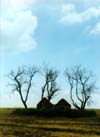
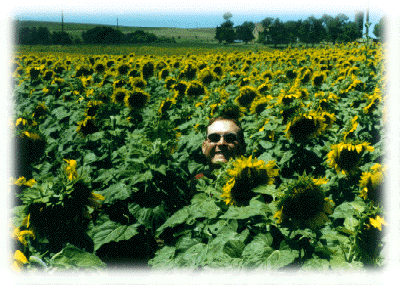
sunset on the Kansas wheat fields


|