|
Day 16 - Wendover to Grantsville, UT
In yesterday's episode, "The Wind and the Wheelers", our indomitable troupe of intrepid cyclists seemed about to be domitabled. The salt flats loomed before them. The desert brooded behind them. The winds wailed, the gymnasium jangled, and cyclist spirits sunk.
But in spite of the fearful forecasts, the bikers booked across the fated flats one hundred and five miles to the little oasis known as Twenty Wells to the Donner Party, which got stuck in the salt flats here, thus delaying their trip enough so they were caught in the Sierras in the winter without enough non-human food to go around, effectively ending the desire of 19th century vegetarians to emigrate west.
Today, this little bedroom community, which has more horses per capita than any other town in the US, is called Grantsville. And as we rolled in to yet another high school gym, we knew we weren't in Nevada any more. For one thing, it's greener. Not lush, but greener. Although when the Mormons arrived in this valley from points east there was very little here, so little that they knew no one else would want it, Brother Brigham saw that there was lots of fresh water rolling down the surrounding mountains, and that meant that him and the 80,000 other Latter Day Saints fleeing persecution could stay. "Brigham made one mistake," says one of our hosts, Craig, a local councilperson and lifetime resident of Grantsville, "He asked God to give them 10 years to build a homeland for the Brethren. God held him to it: 10 years passed and up showed Johnston's army, the largest detachment of federal troops anywhere, sent by Washington to eradicate the Mormons. And although no blood was shed, the presence of the Army put pressure on the Elders to make concessions to the US government which were against the church, compromising the Brethren's dreams for an independent state of Deseret."
Over dinner, then on the ride up the mountains to see the largest pit mine in the world (according to the locals, it and the Great Wall are the only human constructs visible from space) and a spectacular view of the Lake and the whole Valley, and then on the way back down, I got to grill Craig and his fellow host Dar, on Utah history, Mormon culture, their conservative politics, and just about anything else I could think of. They are both the kind of men who collect facts, figures and explanations like they collect rifles and deer heads. And although I can't say I agreed with much of their politics (for my own sanity I stayed clear of gay issues and women's issues, and had to bit my tongue when Craig talked about having a gun in each room of his house, and Clinton being a "radical leftists"), I did unburden myself of many questions I had about Mormons...and distract myself from 105 miles of sore muscles.
Here's the entry for today's ride from last year's route journal:
Today we biked the ocean floor. We were in a deep, flat plain of white salt surrounded by dark mountains that perhaps at their peaks broke the foam above. The sunlight that filtered down in rays allowed scattered green plants to grow close to the bottom. Small fish flitted by our heads, propelled by flapping fins, and the sea monsters of the deep roared by us, churning up the water and sweeping us along in their wakes. They struck terror in our hearts, but in the end, helped us battle the relentless currents that opposed our easterly course. And as the Monsters roared by, they left bits of their shredded black exoskeleton in our path.
With the smell of the sea in our nostrils and a salty crust on our skin, we arrived in Grantsville, and thanked the Lord for our Camelbaks that fed us precious oxygen and made possible our passage across the vast desert of the ocean floor.
------
Days 16-18 - Grantsville to Salt Lake City, UT with rest days.
I may not believe in the Book of Mormon, and I may not be the leader of 80,000 pioneers fleeing persecution, and I may not have 26 wives, but I tell you: me and Brigham Young shared a breath of relief when we came upon the stretch of land nestled between the Great Salt Lake and the Wasatch Mountains.
Brother Brigham saw the potential of this isolated but irrigated spot as a refuge for the Brethren after they'd been chased from their Temples first in Ohio and then in Illinois, a place far enough from the settled States, and far enough into Indian territory to deter other prospectors from competing for the land, and as a place with the natural beauty to build the Latter Day Saints homeland of Deseret. Me? I saw a health food store.
Salt Lake City, like Utah, like America, is filled with strange contradictions: last week the Gay Pride Parade marched past the main LDS Temple, with missionaries agog. As I turned into our home for three nights at the St. Catherine of Siena Newman Catholic Center on campus at the University of Utah, I noticed "Pro-Choice and I Vote" bumper-stickers in the parking lot. The fresh juice stores butted up against family steak houses in the strip malls. The first page of the Yellow Pages lists an equal number of abortion providers and alternatives-to-abortion counselors.
Young punk kids panhandle downtown next to old farmers who've lost everything and turned to drinking. Career women and young, short-haired dykes walk the streets with women who are one of several wives of the same man in town from southern Utah for a sacrament at the Temple, or to shop in the ZCMI mall. Black, brown, yellow and red skinned people ride in the cab that I did with the white driver who told me about the "damn lady-cop who stopped me last week...she was three different colors from one of them islands and she's telling me how to drive."
Father Mike, a young priest at the Newman Center gleefully devours chunks of smoked tofu grilled at our 4th of July party, while a member of his congregation explains that since we're descended from gorillas, it's natural that we eat meat. The pale student I meet practicing magic tricks with a fake racoon in front of the huge projection video screen at the Newman Center showing a how-to video for this latest novelty, is opening a magic store on the Internet next month (www.ILoveMagic.com) and expects aficionados from all over the world to purchase his hard-to-find supplies. He himself has never left Utah. State street, which is 30 miles long or more, starts at the state Capitol and runs past City Hall, but it's North, South, East and West Temple Streets, intersecting at Temple Square under the gold-leafed relief proclaiming this church the center of the Mormon movement, that are also the central thoroughfares from which all the hundreds of other streets are numbered.
St. Peter proclaimed, "On this Rock I shall build my Church," but Brigham Young might have said, "From this Church I shall build my City," complete with Mormon malls, banks, and radio stations. Salt Lake City is no Washington DC or San Francisco, but after the last two weeks of desert ghost towns masquerading as oases, I feel like myself for the first time when, after visiting the Utah Stonewall Center to recharge our gay batteries, Wendy, Doris, and I spread cloth napkins across our laps, dip our fresh focaccia in olive oil and Balsamic vinegar, sip our Chianti and share stories about running gay organizations in San Francisco (Wendy was the Artistic Director of the Lesbian and Gay Band of SF for four years).
I also learn how they got together five years ago: essentially, over a so-so Italian meal first date, Wendy (usually the bolder, brassier one) asked Doris (usually the quieter, more diplomatic one) how her meal was. "It's okay," said Doris, looking straight into Wendy's eyes, "But I'd rather be eating something else..."
I've been feeling bad that I haven't had the energy or ability to do any interviews for my book yet. But the two days in Salt Lake gave me both. The result: my first official interview for my book! The wonderful interviewee is the daughter of a prominent activist from Utah who now lives in San Francisco. 16 year-old Emily lives with her other mom in Ogden, Utah, where she was born. Despite a lot of stigma in this predominantly Mormon town, Emily and her mom (and their dogs, cats, birds, guinea pigs, etc) are out in their town, friends with the neighbors, and generally living the Out life. Emily has found a social and academic niche for herself in which she is thriving. Not only did I get some good pictures (finally a use for the tripod that I've been hauling), but a great interview, AND they let me plug in to send email for the first time in forever (while watching Star Trek...now how cool is that?) Really nice folks, and they kept apologizing for my Grantsville introduction to Utah...saying that it's not all gun-toting good-ol' boys spouting off against that "radical leftist Clinton." Nice to hang with some native Utahans with a different perspective...one that doesn't frighten me. So even if I'm too tired to do another interview from here to DC, at least I've done this one that I wouldn't have done any other way...because I doubt I'll be back in Ogden any time soon. (Notice that I'm trying to talk myself out of the guilt I feel for not doing more than just riding my bike across the country, as if that's not enough.)
As luck would have it, I also got to see Emily the next day...I left my tape recorder and notes at her house an hour a way and she and her rodeo-riding friend, Amber, drove into the big city to deliver them to me (thank goodness...I hadn't even noticed they were gone). It's inspiring to see someone like Emily who is making it through a generally repressive environment with flying colors, figuring out new ways to make an individual, outspoken voice for herself. Kinda gave me hope for the world, ya know? Of course that didn't last long with the Fourth of July festivities in Salt Lake; with the boys riding around in jeeps waving flags, drinking beer and screaming...was it Shaw who said, "patriotism is the last refuge of scoundrels"?
------
Day 21 - Heber City to Duchesne, UT
Even a 15 mile, 2 1/2 hour climb is pure pleasure in the Rockies, so imagine downhills, with every sense heightened by the adrenaline of speed, absorbing the reds, greens and blues of the scenery, the scent of pine and snow and scrub, the rush of cool air against hot skin, the taste of fresh river water flowing from the bottle.
You can't imagine it: I'll show you pictures but they won't do. All I can tell you is that after 75 miles of long climbs, descents, rolling hills, traffic, so-so food, painful points of contact and knees, I was sad to pull into the Duchesne Senior Center for the night, even if they did drive us out in their Meals-on-Wheels van to see a glorious lake-side sunset. I would've kept on riding until darkness fell. Now THIS is a good reason to ride your bike across the country. (Please remind me, when I'm hitting emotional lows in Kansas and Missouri, that the Appalachians are supposed to also be stunning.)
My one regret for the day: I didn't stop in Fruitland to take a picture. Wendy and Doris bought a Fruitland T-shirt that they said I could borrow, though.
------
Day 23 - Vernal, UT to Maybell, CO
Mile 33, 9:20am - B and B Restaurant and Cafe, Dinosaur, CO.
Six year's ago at this time I was reading the notes in our LynchMob log that the night nurse had left a few hours before. I'd slept next door at our neighbor's house, Miriam, who had let me stay in her guest room for several months so that Michael could be in my room on the first floor, and overnight caregivers could stay in his old room upstairs. Although we had a huge care team, we decided on night nurses so that team members could sleep, and be fresh in the morning to make breakfast, clean, and succeed at their day jobs.
In the last few days, Michael had taken a clear turn. He was rarely conscious, he was mouth-breathing when asleep, and his eyes had receded far enough that his lids didn't completely cover them.
It had been maybe 10 days since the mind of the Michael I knew had suddenly up and disappeared, leaving someone with a different affect and a jumble of synthesized and mis-placed memories. He could remember my name, but just barely. So, for me, it was a relief that he was now rarely awake.
The night nurse had recommended in her notes that we get a few things in order to make him more comfortable. Because he was now sleeping with his mouth open for 22 hours a day, it was getting extremely dry. And the same with his half-closed eyes. We needed to get some lozenges for his mouth that would keep it from drying up too much, and we needed to get artificial tears for his eyes.
Although this was new, it wasn't disturbing, since me and most of the other care-team members had long ago grown used to administering medication, massaging away bedsores and bed-sore muscles, and changing Michael's diapers. The challenge was to find these supplies, since we were stretching do-it-yourself home-care (or homo-care as I heard Michael call it once) beyond the parameters of the medical system. You couldn't just march into any drugstore and find these things.
So I had some granola, talked with the person on shift (I can't remember now who that was, but it's all in the logs we kept), and left.
Running errands was usually a big relief for me, I could get out of the house, away from Michael's needs, and needy care-team members, and yet still be doing something important. Whether shopping in Kensington, the permanent farmer's market that Michael used to go an hour out of his way to get to, before we moved into the neighborhood, or picking up meds from Shopper's Drug or Toronto General's pharmacy, I could escape without feeling guilty. Instead of going straight to the usual drugstores, though, to look for these new containers of stuff to add to the piles of pills, drops, cremes, elixirs, powdered asparagus (recommended as an alternative treatment by a friend), measuring spoons, med-timers, mini-whisks for making drug cocktails, thermometers, sphagnomamometers (heart and blood pressure), and Kleenex, I went to Sam's Record Store on Yonge St., a few blocks out of the way, to buy the new Toni Childs CD. Toni Childs is one of the few vocalists who can sound, at will, like an organ: full, loud, rounded, filled with depth. I found her music comforting. Except for that new CD, nothing was special about the day.
Mile 62, 1:45pm, side of route 40 overlooking a valley surrounded by striated mountains. Greens and reds and blues in the flora and rocks, and a stunningly ominous sky casting gargantuan shadows across the scene. They are dripping wet, and if the wind blows the right way, I may be, too. That would be fine if we weren't camping tonight.
This time six years ago I was hovering over the hospital bed in my old room where Michael lay chain-stoking. Ed Jackson, an old friend who had organized the LynchMob and my mom, Gail, are there. I have one hand on a bony thigh.
Chain-stoking is the series of last breaths that a dying person may take. Michael has been, for the last 20 minutes or eternity - depending on how you measure - taking enormous breaths, then letting them go, and not breathing again for several minutes. We don't know after each one if it is the one. Michael regained consciousness for a few minutes not long ago, asked for Gail, tried to say a few more things, none of which were as profound as his own father's last words, "Dorothy, bring be the pot. I gotta take a shit."
Ed has rushed there from his office. Gail had a feeling about today and didn't go off sightseeing with her girlfriend. It turned out only hospitals and hospices have access to the supplies I needed, so as I was ascending in the Toronto General Hospital to the floor where I'd spent time with other people with AIDS, and thus knew where the supply closets were, I had a feeling, too, there'd been something about how deep Michael's sleep had been that morning, so I decided to forego the meds (someone else could look) and go home.
Many other caregivers had heard that there was something going on and were assembling in the living room, talking in hushed, anticipatory voices.
You may think that at this moment I would have been overwhelmed with grief, but that would come a little later. Right now, Ed, Gail and I are focused on letting Michael know through words and touch that it's okay to let go, that we'll be okay, he can leave now. And I was flooding with relief that he might actually do it.
End, 4:45pm, Maybell Camp Ground, Maybell, CO.
Six years ago at this time, I was sitting on the black leather couch in my living room, one by one the care team members had filed into the back room to spend a few moments or an hour with Michael's shrunken body, and as they came out they might try to console me or Gail, or they might see the relief on our faces and think better of it. I watched how differently people reacted: some matter-of-factly, some with shock, some with sadness, some not at all. Jeff, the doctor, had come to write the death certificate, Harold the evening's nurse had shown up only to find his ward dead...so we asked him a few questions about how to treat a dead body, and sent him on his way. Someone had called the funeral home that would return his cremains to us in a plastic cube, they were heavier than I'd expected. The funeral home had said it was okay to leave the body in the bed over night, which we did as Gail and I shared the upstairs bed, and they would come in the morning.
Next to relief, I was also stunned: this had been the focus of four years of preparation and effort and psychic energy. Now what? You mean I could just pick up and go to the International Fireworks competition down at Harbourfront like I did that night with Gail and her girlfriend? You mean I could sleep in? You mean this house is now mine and I could or could not clean it at will? I was overwhelmed not by the grief which I'd been having in loads years before this day, but by the new freedom and accompanying responsibilities. I'd come along for the ride, but now it was over and I was going to have to build my own road.
Today's 90 mile ride included, for me, 2 oversized loads edging into the shoulder, two flats and a slow leak, a deformed rear wheel to true, 30 miles of big rolling hills, including a 1/2 hour ascent followed by a 50 mph descent, storms with lightning which lead me to flatten myself and my bike against an embankment until we were less likely targets, a waitress at the B and B restaurant who took 45 minutes to bring me my check, 90 degree heat, seriously gross roadkill, and nosy riders and flies who wouldn't leave me to type in peace. But I made it, and even managed to enjoy it. And I'm a stronger, and more confident rider because of it.
I dedicate my ride today to those folks who helped me grow and learn and thrive after Michael died, in short be a stronger rider in a grand sense. Gail Lynch, Rodney Christopher, Shani Ferguson, Natalie Zlodre, Hope Berry, and Jim Monsonis: what I did today is in honor of you.
------
Day 24 - Maybell to Steamboat Springs, CO
I suppose that since the bourgeoisie make money, and if too much of it accumulated in one place the bourgeoisie might become a serious threat to the corporate hegemony, we need places like Steamboat Springs, Colorado, that offer copious cute, clean options, lining every street, for people to unload themselves of the burden that is money, in exchange for chandeliers made from hand-carved elk horns, restaurants with buffalo steaks, and "general stores" with $200 cowboy boots so you don't get callused stepping on the accelerator of your Sport Utility Vehicle.
Why the acrimony? Well, the real problem is: I like this tourist trap nestled up against the western edge of the Continental Divide, on the Yampa River which flowed next to most of our gorgeous ride today. I don't particularly like that I like it here. It's all white, filled with tourons (that's the all too common tourist-moron...), gun shops, faux-Western wear stores (get your made-in-Taiwan chaps for that East/West look) and restaurants serving huge slabs of meat to visitors looking not just for the fashion, but for the taste of the Old West. But here I am liking it...I mean they have a nice health food store, and the houses are pretty, and the public elementary school we are sleeping in has a carpeted gymnasium and an artist in residence. And showers. So what am I to think of myself?
Well for one thing, I now know that you can get a cyclist to do anything for you if you've just cooked them a good meal. I had tough guys in the group giving me hugs and foot massages. I had three women giving me a back and head massage simultaneously. I've had offers to pack my stuff for me, to clean up everything for me, to even ride my bike for me over the Rockies, which we do in earnest tomorrow and the next day. All this from some curried lentils and steamed vegetables...what fantasies could I have fulfilled had I cooked the Thai coconut curry over rice noodles that I WANTed to make...the mind reels. Of course there are certain obligations that come with being someone who can actually chop an onion and buy curry powder. Expectations are running high, and I feel the pressure. Even today, I rushed the ride almost to exhaustion so that I'd have time to cook before people went mad with hunger. Making food for 23 people after you've ridden 75 miles in 5 hours is an altogether different act than my usual efforts.
So you notice that I changed the subject away from my contradictory feelings about Steamboat Springs. I think it's a sign of aging that I can not so easily change my emotional reaction to something that intellectually I may despise. Or maybe it's that the will to change, not the ability, is waning. I think of myself as an idealistic person, and to me that's a good thing. Idealists, to me, are people who live what's real everyday just like everyone else, but have broader, perhaps unattainable goals that give meaning and purpose to the quotidian. But it's so easy to get caught up in the baby steps and begin to think they are the goal. Running COLAGE was not about answering the phone or raising money, even though that's what it seemed like, it was about helping to liberate a group of kids oppressed because their parents are gay. And that goal is really just a step towards broader social justice, which is in turn a step towards re-organizing the anti-human ways of the institutions we ourselves create, whether that's economic systems, governmental systems, or most evident to me in the last few weeks, transportation systems.
Many of the current ways we move ourselves and our stuff around not only hurt us by hurting our environment, but hurt us by keeping us so separated from one another for hours a day...cars may make long-distance relationships, work and amusement easier, but they also atomize us, not just from the natural world, but from the people around us. And car-based communities, as I've seen on this ride, are really not communities, they are conglomerates of stores and houses so spread out that you need never meet your neighbor or care about what's around you because you get in your car to buy a quart of soymilk. And, since cars have facilitated the commute as a way of life, we are no longer working in the places that we live. Thus the impact of our production is removed from our lives, discouraging any involvement in improving that impact. When one lives and works in the same community, one is accountable to one's neighbors and self for the effects that your work may have there.
So how do I incorporate my increasing absence of will to change how I live or feel, with ideals which have yet to waiver. In some sense this is a classic dilemma, even a significant part of many people's "mid-life" crises. The difference for me, I think, is that a mid-life crisis occurs after having gotten so absorbed with the baby steps that you've forgotten the bigger picture: the ideals and dreams...and when you realize that, there is a conflict between the person that is, and the person that you once envisioned yourself being. I'd like to avoid that by never forgetting those big ticket items. So the problem is, how to live and pursue those ideals that I refuse to forget, especially when I am increasingly wooed by the aseptic comforts of Steamboat Springs. More lentils anyone?
------
Day 25 - Steamboat Springs to Walden, CO
Do Me Me
Me So So
Ra Fa Fa
La Te Te
Do Me Me
Me So So
Ra Fa Fa
La Te Te
(repeat, while I do...)
When You Know The Notes To Sing,
You Can Sing Most Any Thing.
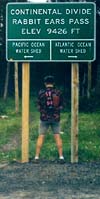
Now continue singing as I did while you ride down a highway surrounded by aspen and pine, streams gurgling their way through fields of wildflowers with snowcapped mountains framing all. You've just topped Rabbit Ears Pass in the Rockies, which at 9,200 feet is the second highest point you will reach. To get there, you had to ride 15 miles uphill through national forest. The sign at the top says, "Continental Divide," on the left "Pacific Watershed" and on the right, "Atlantic Watershed" so you make sure to leave a continent-wide mark by peeing on each side.
now it's 40 miles later in Walden, CO "Moose Viewing Capitol of the US". However you have not viewed any moose.
repeat after me:
I said a Boom Chicka Boom
(you)
I said a Boom Chicka boom
(you)
I said a Boom Chicka Rocka Chicka Rocka Chicka Boom
(you)
One more time, Cow style...
(you)
I Said a Moo Chicka moo...
You're in the back of a cattle trailer with 13 other cyclists, your bikes, and dozen of your enormous duffel bags which carry everything you think you need this summer. You're riding down a 15 mile dirt road to the ranch you'll be eating and sleeping at tonight. They've got 7,000 acres, but you only need a few square meters for your tent. You're singing camp songs to pass the time because the humor of sticking your nose out the sides of the trailer and all going, "moo" has warn off. The excitement of your surprising strength in climbing several thousand feet today, scaling the Rockies which seemed so ominous just a few weeks ago, still remains. You are restless with it and start another song with the group:
Little Bunny Foo Foo, Hopping through the forest, Picking of the field mice and Bopping them on the head...
------
Day 26 - Walden to Fort Collins, CO
I've been trying to avoid regular travel journal entries: "We went to this place and saw that thing and ate this and such, and the weather was like whatsiwazzit" I mean, I would get bored writing like that, so I figure you, my reader, would too. I can only say, "I rode my bike over a hill that was this high and saw scenery that looked pretty and went this far and found a health food store," a few times before you start skimming and I start sounding like one of those obsessive-compulsives who has to write down everything they did each day and what the temperature was and how many calories was in their oatmeal with raisins and cinnamon. So instead I try to record what I've been thinking and feeling on the ride that day, maybe introduce some distance, weather or human interest for some drama, but really the meat of what I'm trying to record is my reactions to all of that, intellectually and emotionally.
But today I must make an exception, because I think in the simple descriptions I offer, you will have your own emotional reactions, or accurate guess mine. I will only offer this one bit of affective commentary: It was a damn good day.
I awoke this morning to a drop of water bouncing on my forehead. A low fog had settled in the North Park valley in the high Rockies where Jackie and Jim's ranch sits on 6,200 acres, and soaked my tent. Breakfast was being served already, completely vegetarian like last night's dinner, even though Jim and Jackie run 300 head of cattle for a living. I gobbled down some half-frozen fruit, and a glass of Sunny D, then stuffed my damp sleeping bag away, piled my bags by our van, and began my morning regimen of pacing to warm up my legs. As usual, I did not copy down the directions for the day's ride, relying on fate, the sun, and kind souls on the road to guide me.
21 riders and their bicycles loaded once again onto Jim's horse trailer for the 15 mile dirt-road ride into Walden. This time we sang Annie songs, "It's a hard knock life, for us..." as we bounced our way through green pastures, shouting at the apathetic cows, "Revolt! Revolt!"
Julie had a flat, and manure all over her shirt, when we unloaded the trailer. So several of us who have some connection to her stayed around to help patch and clean. It was exhausting enough that the five of us decided to eat breakfast before our 100 mile ride.
Walden's premier cafe, as any local will tell you, is the Golden Coffee Pot. The cafe and used book room in the back, offering a selection from "Cheerleaders solve the Mystery of the Missing Gym Shoes" to "Catch-22" to "Understanding Ritual Satanic Abuse: a book for kids" are both owned by a woman who has been waiting tables for 54 years. She tells us off jokes as we wait for our homefries and OJ, "The blonde gets tired of everyone thinking she's dumb, so she dyes her hair black. Soon after, she's out for a leisurely drive through the countryside when she comes upon a shepherd and his flock. She says, 'excuse me Mr. shepherd, but if I can guess how many sheep you've got, would you give me any one that I choose?' Says he, 'That's quite impossible, but you could go ahead and try.' So she wanders among the sheep for a few moments and turns to the herder to say, 'I guess you've got 967 sheep here.' 'By golly, you're right! Well, a bet's a bet, go ahead and pick one.' She wanders among the sheep for a long time, and finally leads one back to her car and is about to drive off, when the shepherd says, 'pardon me ma'am, but if I can guess your natural hair color, would you give me back my dog?'"
She told us her name is Coffee Pot, because for as long as she's been serving folks going on long drives, she's been giving them free coffee to make sure they make it safe. Apparently, the name caught on, and her loyal fans from around the country regularly send her normal and unusual coffee pots. "I've got 1,531 of em so far," she says pointing to a row along the wall, "You see that giant wood one out front? A man who lives in Topeka, Kansas carved that with a chainsaw and hauled it all the way here for me." Coffee Pot says that her autobiography is due out next year, "because I've served coffee to a lot of interesting people." For the record, none of us had coffee.
There was a strong head-wind and cross-wind coming out of town, blowing me off the road a few times, and making a long ride out of the first 15 miles of a 100 mile day. But when I started up the pass that would bring us to the other side, the wind suddenly shifted, and for only the second time in four weeks, I was being pushed from behind. Up I went through evergreens and red rock, looming snow covered peaks just above. A local sheriff when asked if people helicopter ski these peaks said, "Oh no, this is avalanche country." So I hum instead of belt out "The Hills are Alive, With the sound of music..."
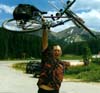
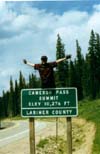
Because we were already over 8,500 feet, Cameron Pass comes up within an hour of the start of the climb. At 10,300 feet, this is our highest point in the ride, so the group of us there takes each other's photos: a traditional Bike-Aid pose, huge grin, bike held high over head, mountains or pass road sign in the background. We strike many poses and use much film because we are fabulous.
We've been told that the next 70 miles into Fort Collins are downhill. Wendy and Doris start first, I'm close behind. I listen to these 47 year-old women as they hoot and holler. I watch as they try to pass each other, legs pumping furiously even though they could easily coast at 35 mph. They have just climbed the Rockies on their bikes, and now is the pay-off.
Cache la Poudre canyon is a raucous admixture of blue sky, red rock, black road, green pine and white water. Going at speeds my mother has asked me not to name, the hues blur in my wind-wet eyes, my heart pumps faster than during the ascent.
In Rustic, CO, we stop the mad rush for veggie burgers and lemonade: surprised by our hunger despite the leg-friendly downhills. We learn that Holly, a rider who injured her knee early on, has decided to leave the ride and head back to Buffalo. A kid steals Danesh's camera, but his parents discover it a few miles down the road, and guiltily bring it back while we are still eating. As we set out again, it's 5pm and we have 50 miles to go before dark.
After 40 more miles of curving canyon road, we suddenly find ourselves in the middle of open fields, on flat land for the first time since Salt Lake City. Although I have been assured that one cannot get altitude sickness in reverse, the atmosphere is heady and thick.
There is a barbecue going as our group, the last riders of the day, pull into the Family Housing complex of Colorado State University. I grab salad and corn and water and settle down to gorge with my friends. But one of our hosts - many of whom are involved with a local chapter of the Overseas Development Network which produces Bike-Aid - looks familiar. However she is the one who says, "you look familiar" first. "Did you go to Simon's Rock?" she asks, and then identifies me by name; a feat since I was a freshling when she was a thesis-crazed senior, and that was nine years ago. We hug, a traditional Simon's Rock greeting, even though at the time we went to school together, we most likely said less than 10 words to each other. She introduces me to her husband, Mike, and invites me to stay at her apartment for the night so we can gossip.
Kyra Ryan was intimidating back in '88. She was angry, radical, smart and motivated. Kyra Ryan today is less sure of her convictions, and even blurrier on how to carry them out. She met her husband at a restaurant they both worked at on Martha's Vineyard, and they have lived a number of places since then, including England, from where Kyra was deported, cementing their decision to marry. They also lived for a year at Shotwell and 17th, two blocks from where I would live in San Francisco. Mike is in Fort Collins to study Hydrology, and he's loving it. Kyra is here getting an MFA in creative writing, and not loving it. As I've heard before from many peers who've continued their formal education, Kyra says, "It's all downhill after Simon's Rock."
Kyra, it turns out, is from a multi-racial family: white mom and black step-dad since she was 7. Her little brother is bi-racial. We stayed up until 1am comparing and contrasting our family experiences, and how that's impacted our lives. Kyra, who is white, sometimes feels like she's falsely included in groups of white people, just as I feel falsely included in groups of straight men. We talked about privilege and how we see our own and others more than our peers who take it for granted. We talked about growing up with a fear of the police; she still turns down her car radio when a cop drives past. There's the stigma in school that comes from who your parents are. We went on, all the while pointing out which professor we picked up the language or analysis we were using: "As a woman I'm marked, but as a white person I'm unmarked, yet I don't feel that way because I'm aware of my position in a way that other whites aren't." "Fran Mascia-Lees and Pat Sharpe!" I squeal at hearing the language of "markings" again. Kyra and I exchange email addresses, fast friends, and then it's off to bed; the first mattress and pillow I've slept on in since Hope's back room, woo me into a deep sleep filled with dreams of my father.
------
Onto the next section
Back to main page
|
|